Saji Chuka VG-10 Damascus 220mm (8.7")
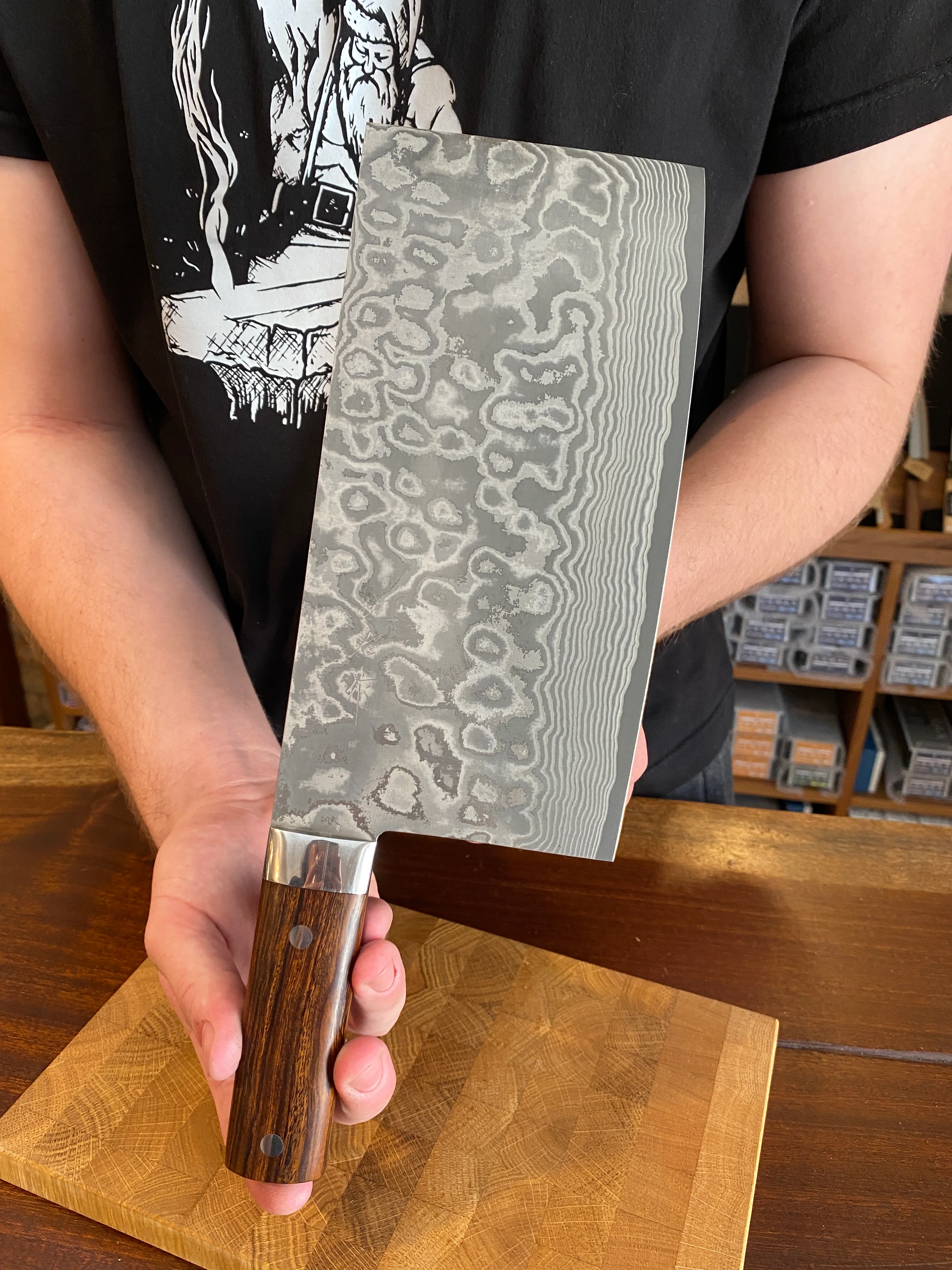
It’s not just about size, it’s how you use it. With this monumental piece from Takeshi Saji, this saying absolutely holds water. This knife takes an experienced—and strong while you're at it—hand to properly utilize. Coming with a handle of equal heft and presence, as a knife of such magnitude needs it to be handled properly.
Chuka 中華, is a term used for Chinese-Japanese cuisine that developed in Japan, under the influence of Chinese immigrants. It combines elements of both cooking styles, and in similar fashion, the master blacksmith integrated components of both the cultures’ cutlery traditions. In Chinese kitchens, such large knives are widely used, as their flat and tall blades are great for chopping and easy food transfer, but are made of softer stainless steels. Saji opted for VG-10 steel, with similar easygoing stainless characteristics, but a high carbon content and hardness upwards of 60 HRC. Plus, of course, Saji-san’s magic touch, making this knife nothing to joke about in terms of chopping performance.
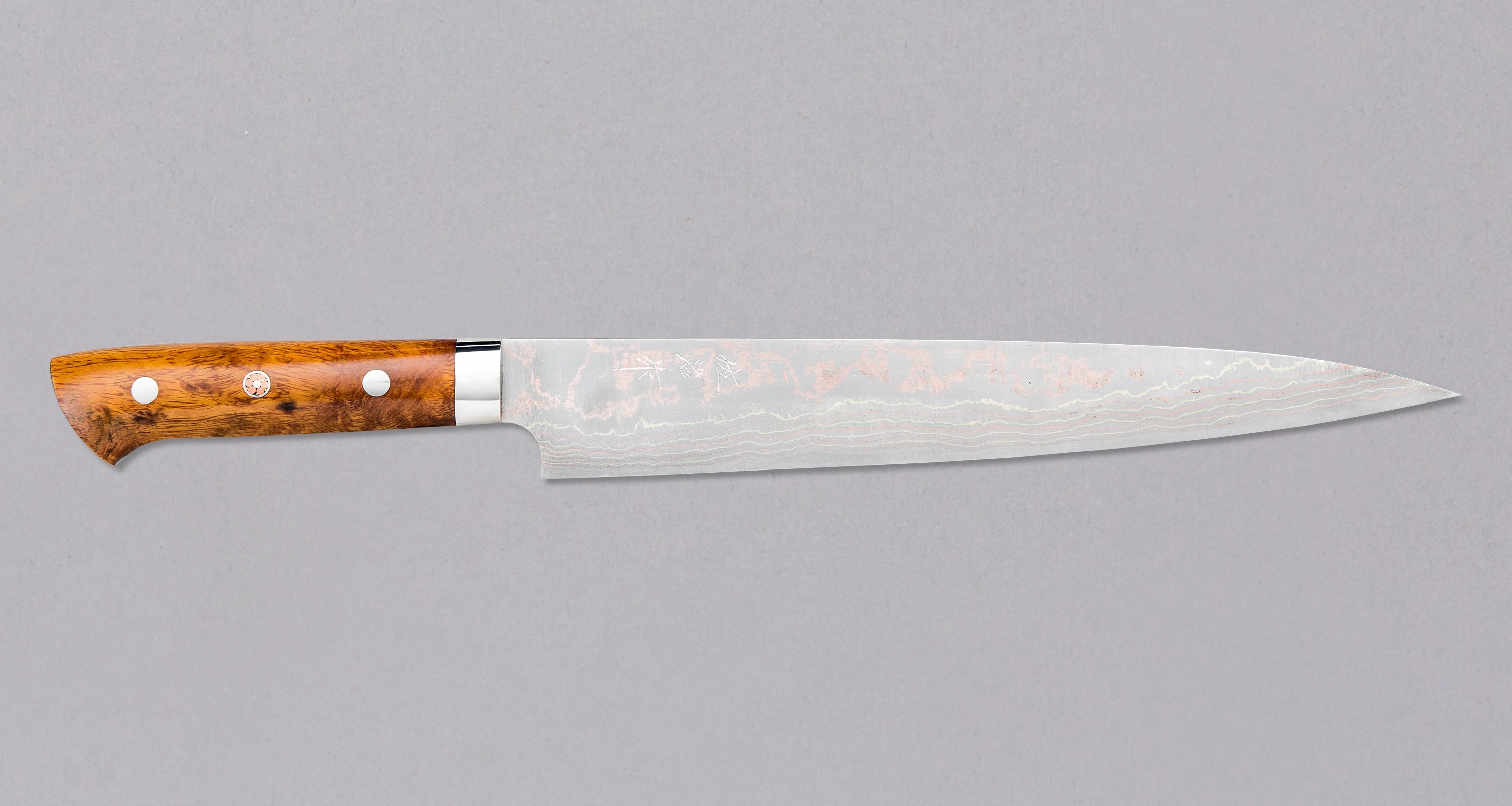
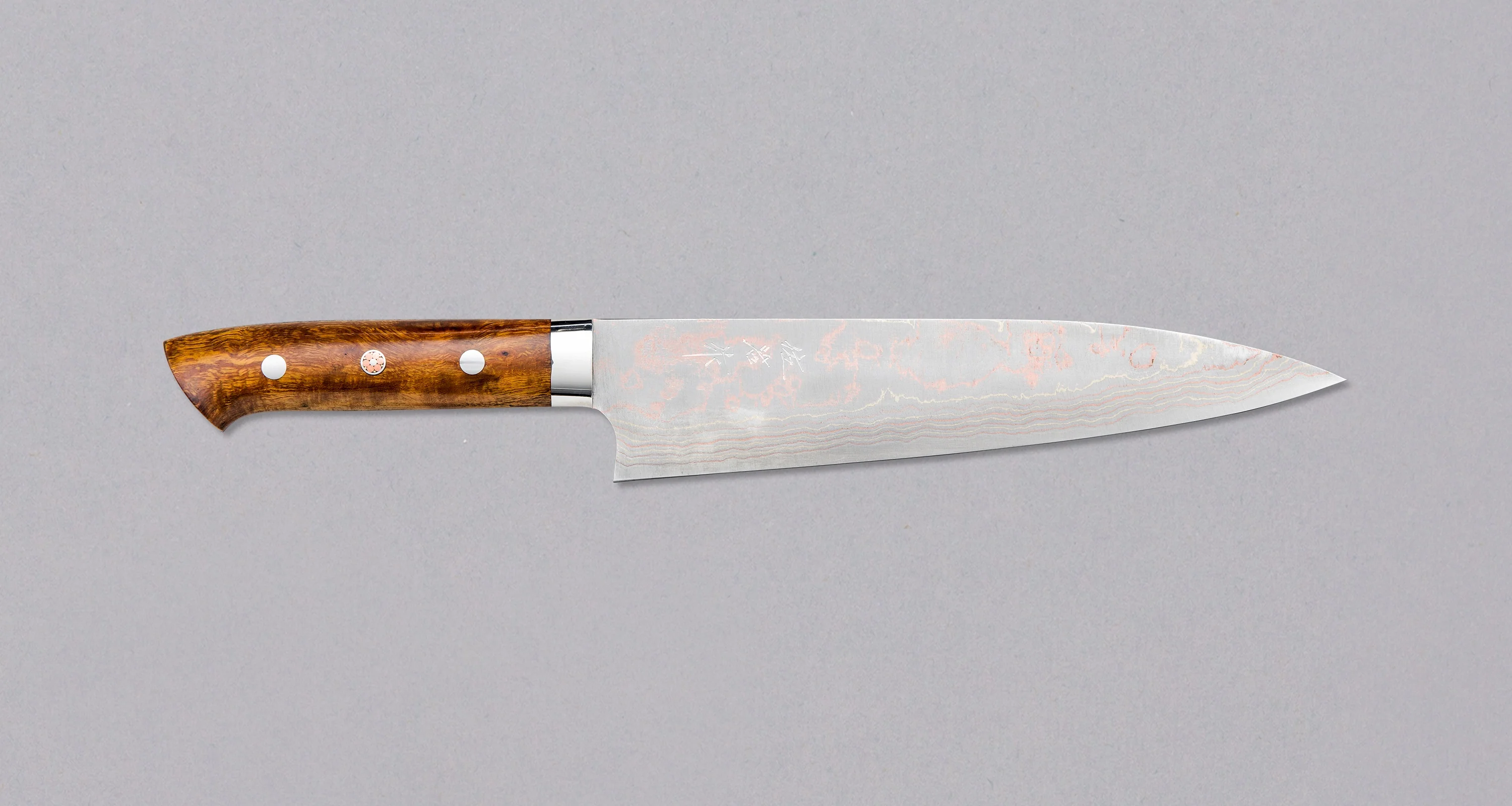
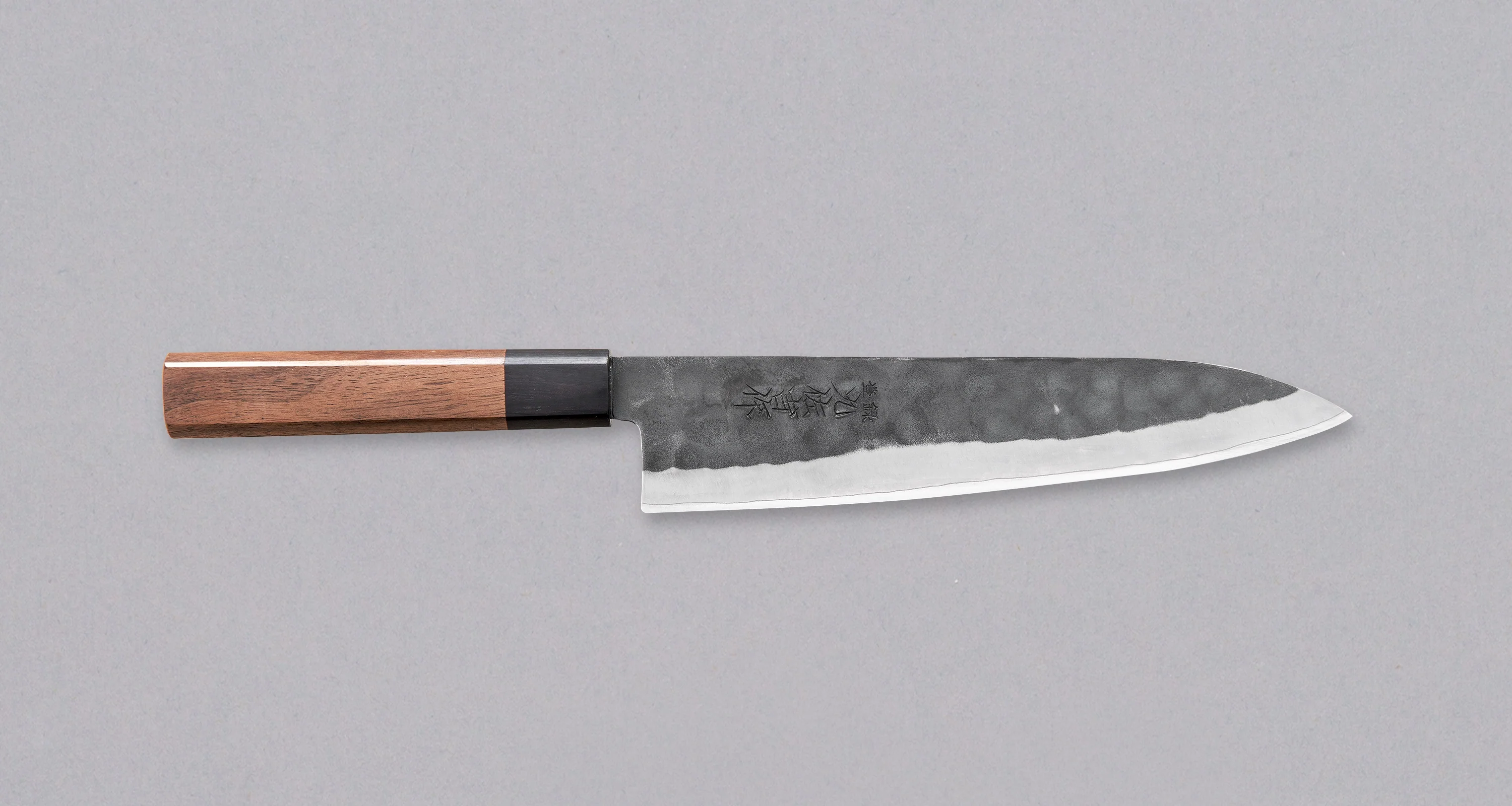
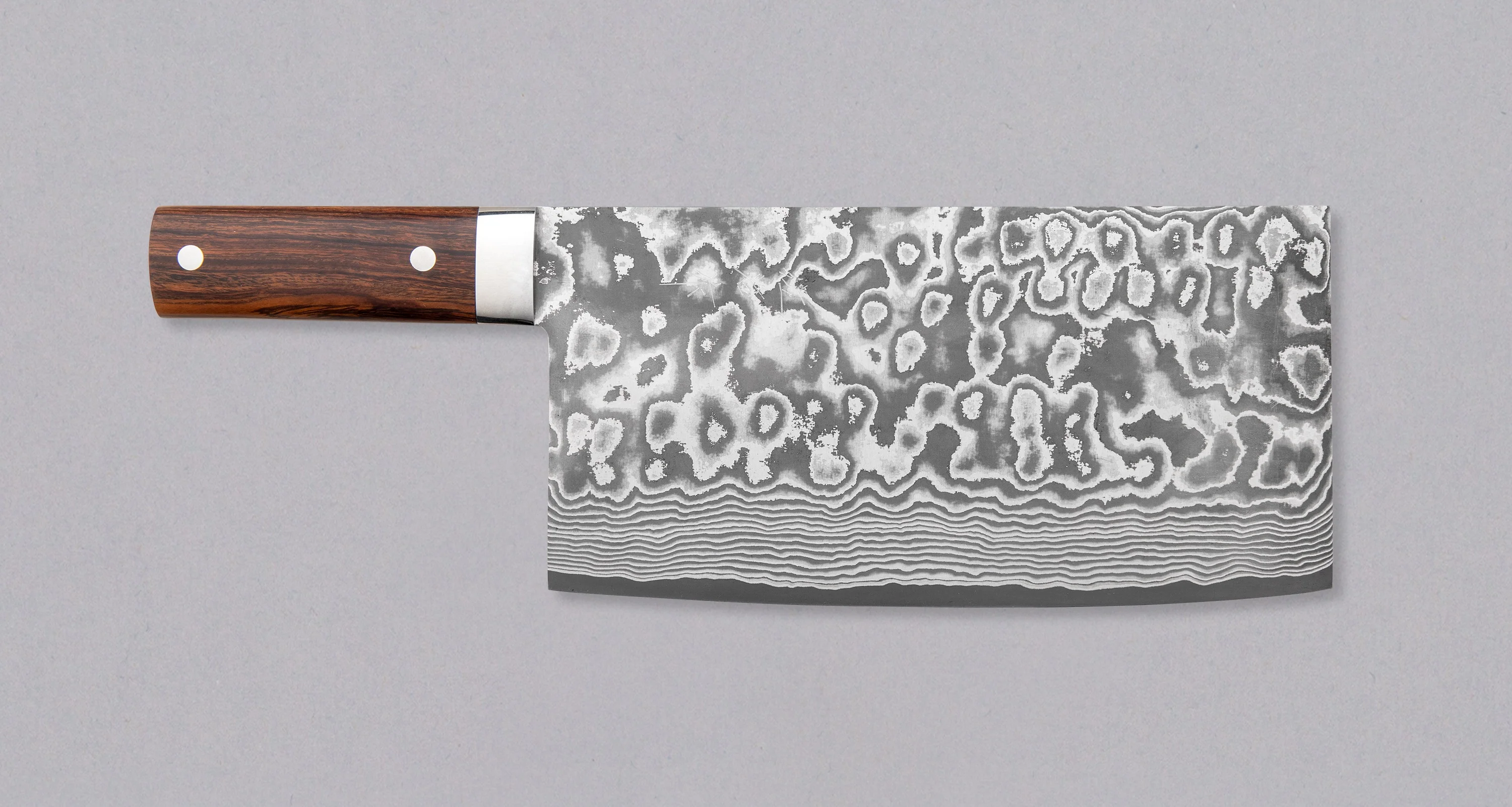
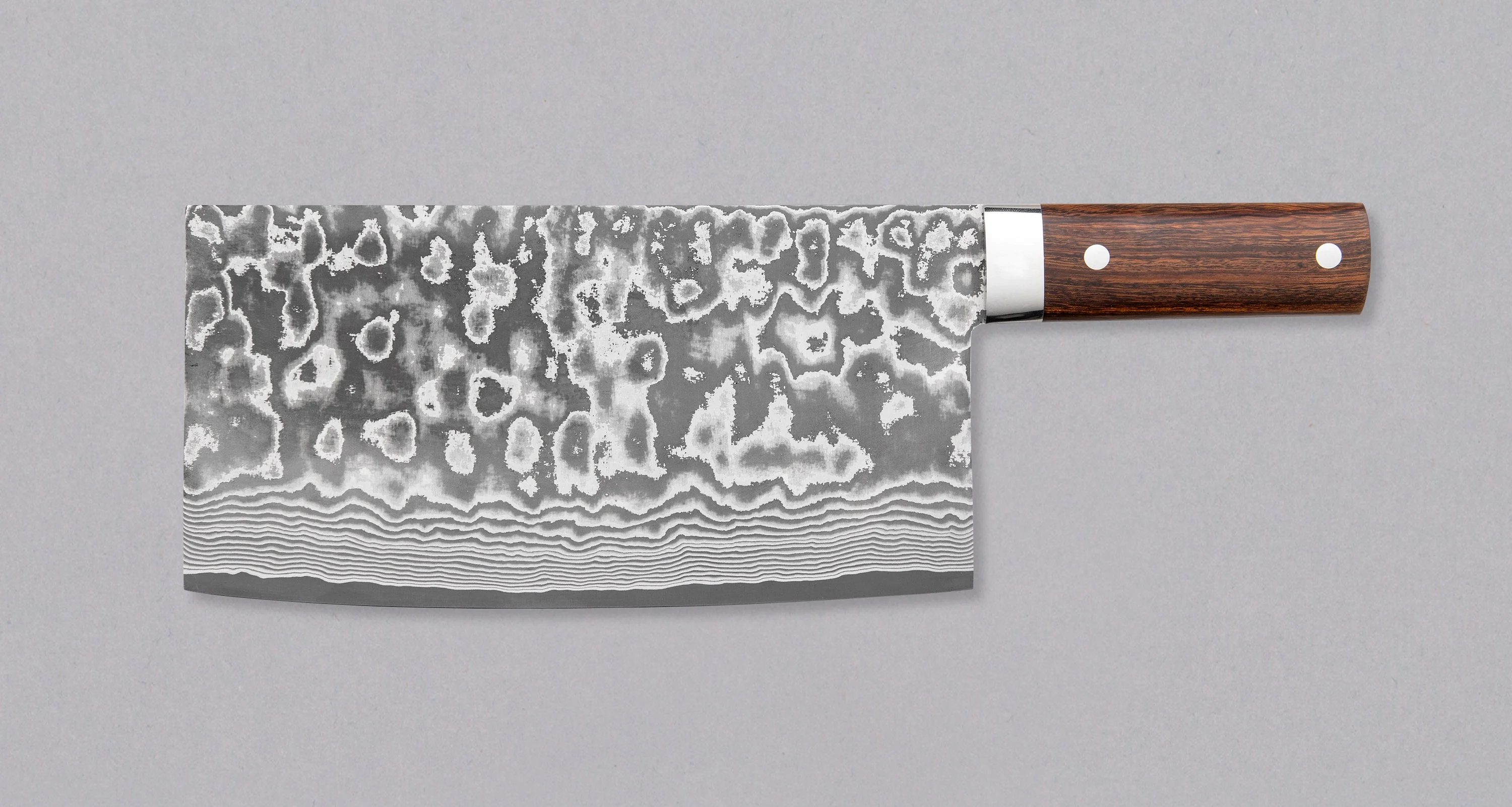
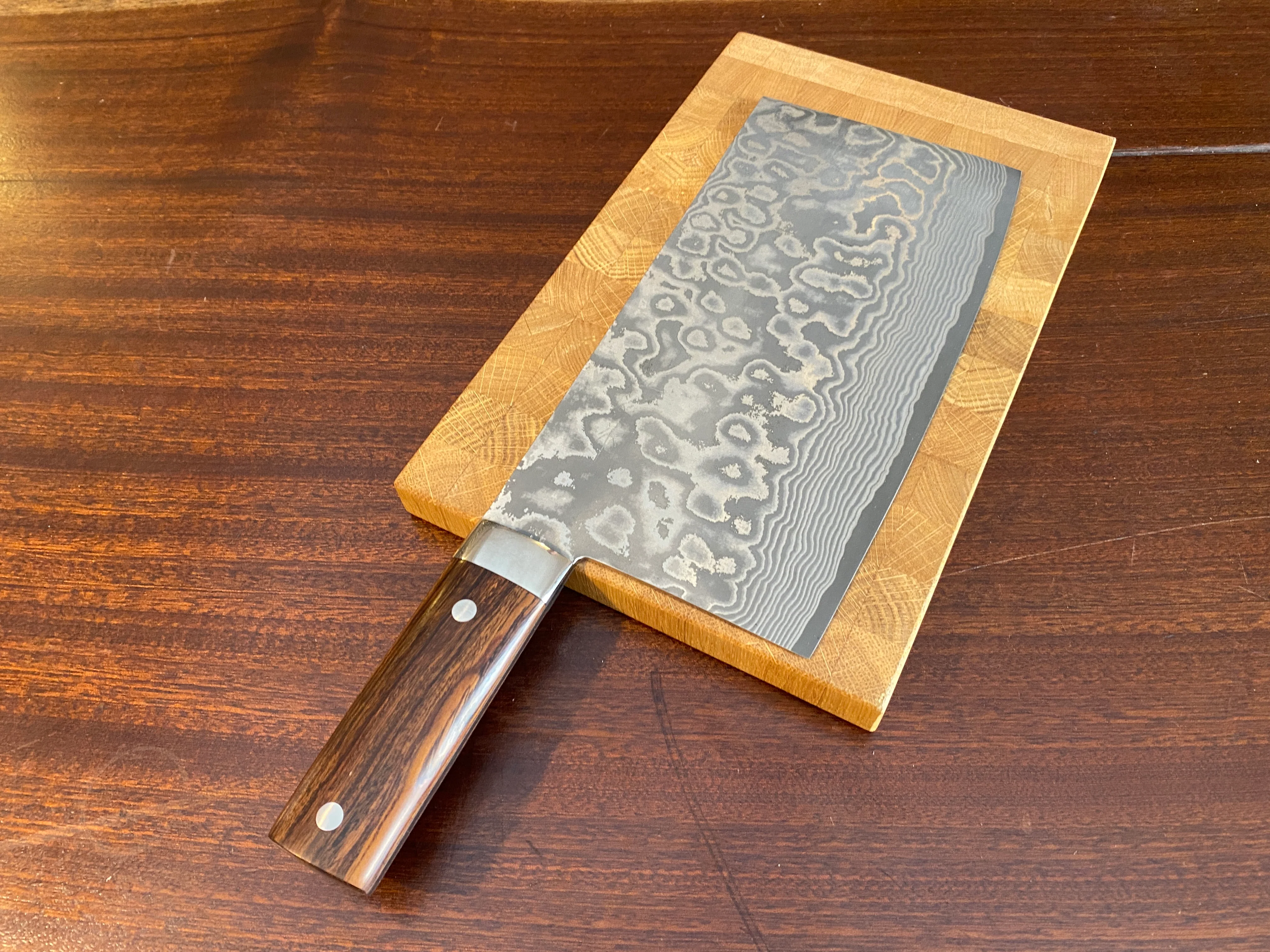
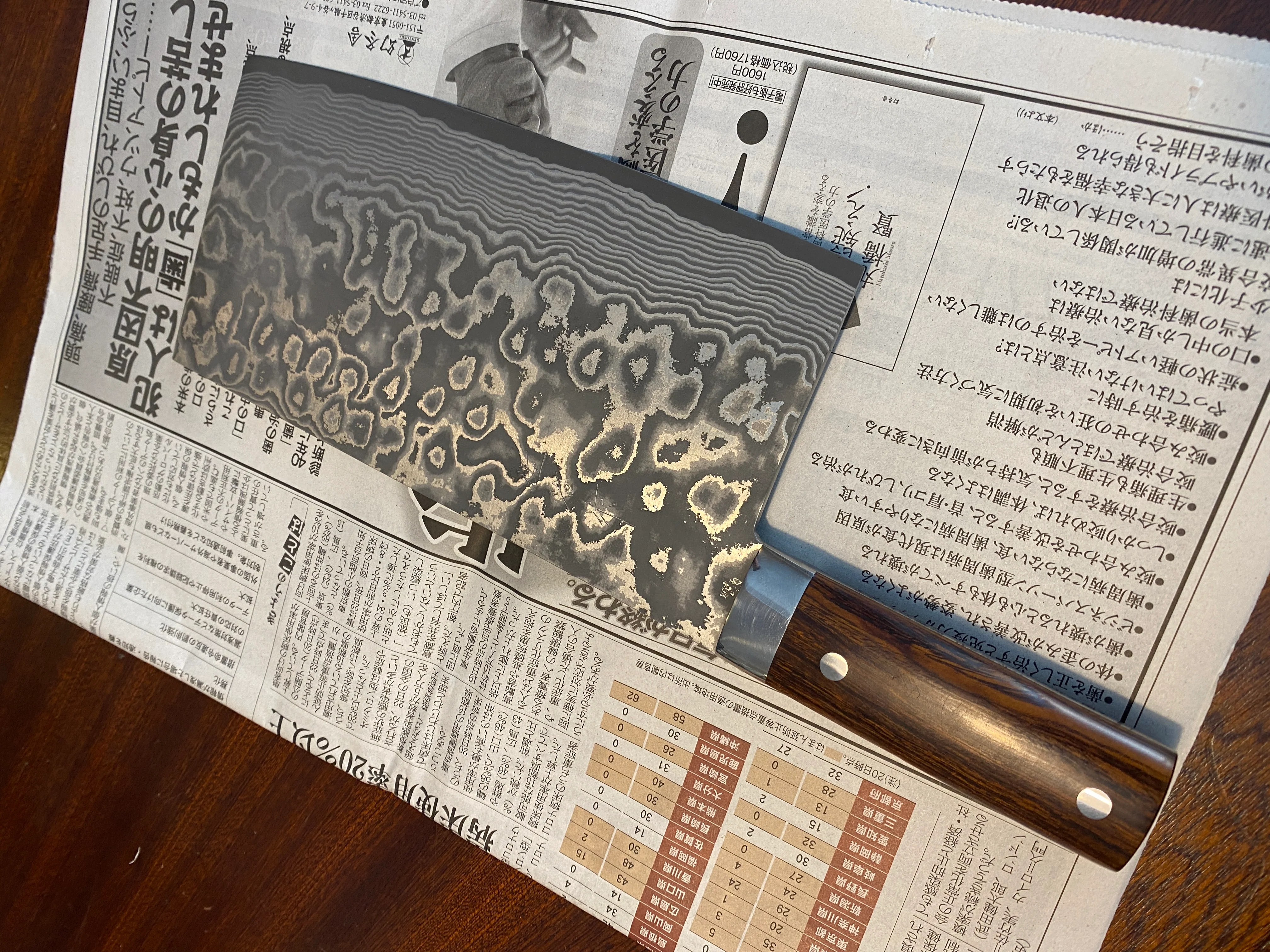
Of course, he added a bit of his recognizable style and grandeur. The large surface of this blade almost works as a canvas for the maestro Saji-san, showing off a beautiful damascus finish that starts as a vast landscape of shadowy terrain and then transforms into layers of wavy alternating steel. The cutting edge or kireha was etched with acid to achieve a dark forced patina and match the blackish appearance of the blade.
BLADE SHAPE:
In Chinese kitchens, the bulk of the work is usually done with just one knife. The large cleaver shape is great for chopping and easy food transfer, with an added heft that allows the user to hack through harder produce (🚨 but not through bones and joints!). Longer slicing motions, as well as finer techniques such as mincing, dicing or the julienne are no trouble for the Chinese cleaver, either, due to the long and thin cutting edge.
STEEL:
VG-10 (V for Vanadium, G for "gold" as in "gold standard") is made by Takefu Special Steel Company, a relatively small steel company that around 60 years ago managed to find just the right balance of different elements to create the most popular Japanese knife making steel today. VG-10 steel is stainless steel with relatively high Carbon (C) content (1%), 15% Chromium (Cr), 1% Molybdenum (Mo), 0.3% Vanadium (V) and 1.5% Cobalt (Co). The combination of Cr, Mo, and V forms a lot of hard carbides, making the steel abrasion resistant which translates to long-lasting, smooth sharpness.
LAMINATION:
The core layer consisting of VG-10 steel was sandwiched between layers of softer, pliable steel that had been forged together to create a rippling damascus pattern. This technique is called san-mai and is used to protect the hard (but delicate) core from outside factors and physical impacts, which could lead to breakage.
GEOMETRY:
It has a double bevel (symmetrical) blade.
BLADE FINISH:
The blade sports a beautiful dark 15-layer nickel Damascus finish.
HANDLE:
The Western style (Yo) handle is made of very dense and durable ironwood.
More Images
Saji Chuka VG-10 Damascus 220mm (8.7")
It’s not just about size, it’s how you use it. With this monumental piece from Takeshi Saji, this saying absolutely holds water. This knife takes an experienced—and strong while you're at it—hand to properly utilize. Coming with a handle of equal heft and presence, as a knife of such magnitude needs it to be handled properly.
Chuka 中華, is a term used for Chinese-Japanese cuisine that developed in Japan, under the influence of Chinese immigrants. It combines elements of both cooking styles, and in similar fashion, the master blacksmith integrated components of both the cultures’ cutlery traditions. In Chinese kitchens, such large knives are widely used, as their flat and tall blades are great for chopping and easy food transfer, but are made of softer stainless steels. Saji opted for VG-10 steel, with similar easygoing stainless characteristics, but a high carbon content and hardness upwards of 60 HRC. Plus, of course, Saji-san’s magic touch, making this knife nothing to joke about in terms of chopping performance.
Of course, he added a bit of his recognizable style and grandeur. The large surface of this blade almost works as a canvas for the maestro Saji-san, showing off a beautiful damascus finish that starts as a vast landscape of shadowy terrain and then transforms into layers of wavy alternating steel. The cutting edge or kireha was etched with acid to achieve a dark forced patina and match the blackish appearance of the blade.
BLADE SHAPE:
In Chinese kitchens, the bulk of the work is usually done with just one knife. The large cleaver shape is great for chopping and easy food transfer, with an added heft that allows the user to hack through harder produce (🚨 but not through bones and joints!). Longer slicing motions, as well as finer techniques such as mincing, dicing or the julienne are no trouble for the Chinese cleaver, either, due to the long and thin cutting edge.
STEEL:
VG-10 (V for Vanadium, G for "gold" as in "gold standard") is made by Takefu Special Steel Company, a relatively small steel company that around 60 years ago managed to find just the right balance of different elements to create the most popular Japanese knife making steel today. VG-10 steel is stainless steel with relatively high Carbon (C) content (1%), 15% Chromium (Cr), 1% Molybdenum (Mo), 0.3% Vanadium (V) and 1.5% Cobalt (Co). The combination of Cr, Mo, and V forms a lot of hard carbides, making the steel abrasion resistant which translates to long-lasting, smooth sharpness.
LAMINATION:
The core layer consisting of VG-10 steel was sandwiched between layers of softer, pliable steel that had been forged together to create a rippling damascus pattern. This technique is called san-mai and is used to protect the hard (but delicate) core from outside factors and physical impacts, which could lead to breakage.
GEOMETRY:
It has a double bevel (symmetrical) blade.
BLADE FINISH:
The blade sports a beautiful dark 15-layer nickel Damascus finish.
HANDLE:
The Western style (Yo) handle is made of very dense and durable ironwood.
Product Information
Product Information
Shipping & Returns
Shipping & Returns
Description
It’s not just about size, it’s how you use it. With this monumental piece from Takeshi Saji, this saying absolutely holds water. This knife takes an experienced—and strong while you're at it—hand to properly utilize. Coming with a handle of equal heft and presence, as a knife of such magnitude needs it to be handled properly.
Chuka 中華, is a term used for Chinese-Japanese cuisine that developed in Japan, under the influence of Chinese immigrants. It combines elements of both cooking styles, and in similar fashion, the master blacksmith integrated components of both the cultures’ cutlery traditions. In Chinese kitchens, such large knives are widely used, as their flat and tall blades are great for chopping and easy food transfer, but are made of softer stainless steels. Saji opted for VG-10 steel, with similar easygoing stainless characteristics, but a high carbon content and hardness upwards of 60 HRC. Plus, of course, Saji-san’s magic touch, making this knife nothing to joke about in terms of chopping performance.
Of course, he added a bit of his recognizable style and grandeur. The large surface of this blade almost works as a canvas for the maestro Saji-san, showing off a beautiful damascus finish that starts as a vast landscape of shadowy terrain and then transforms into layers of wavy alternating steel. The cutting edge or kireha was etched with acid to achieve a dark forced patina and match the blackish appearance of the blade.
BLADE SHAPE:
In Chinese kitchens, the bulk of the work is usually done with just one knife. The large cleaver shape is great for chopping and easy food transfer, with an added heft that allows the user to hack through harder produce (🚨 but not through bones and joints!). Longer slicing motions, as well as finer techniques such as mincing, dicing or the julienne are no trouble for the Chinese cleaver, either, due to the long and thin cutting edge.
STEEL:
VG-10 (V for Vanadium, G for "gold" as in "gold standard") is made by Takefu Special Steel Company, a relatively small steel company that around 60 years ago managed to find just the right balance of different elements to create the most popular Japanese knife making steel today. VG-10 steel is stainless steel with relatively high Carbon (C) content (1%), 15% Chromium (Cr), 1% Molybdenum (Mo), 0.3% Vanadium (V) and 1.5% Cobalt (Co). The combination of Cr, Mo, and V forms a lot of hard carbides, making the steel abrasion resistant which translates to long-lasting, smooth sharpness.
LAMINATION:
The core layer consisting of VG-10 steel was sandwiched between layers of softer, pliable steel that had been forged together to create a rippling damascus pattern. This technique is called san-mai and is used to protect the hard (but delicate) core from outside factors and physical impacts, which could lead to breakage.
GEOMETRY:
It has a double bevel (symmetrical) blade.
BLADE FINISH:
The blade sports a beautiful dark 15-layer nickel Damascus finish.
HANDLE:
The Western style (Yo) handle is made of very dense and durable ironwood.