![Yoshida Santoku Funayuki SUJ-2 Kuro-uchi 155mm (6.1") [Magnolia]](/images/sharpedgestore.shop/images/product/kuro-uchi-santoku-funayuki-155mm-1.jpg)
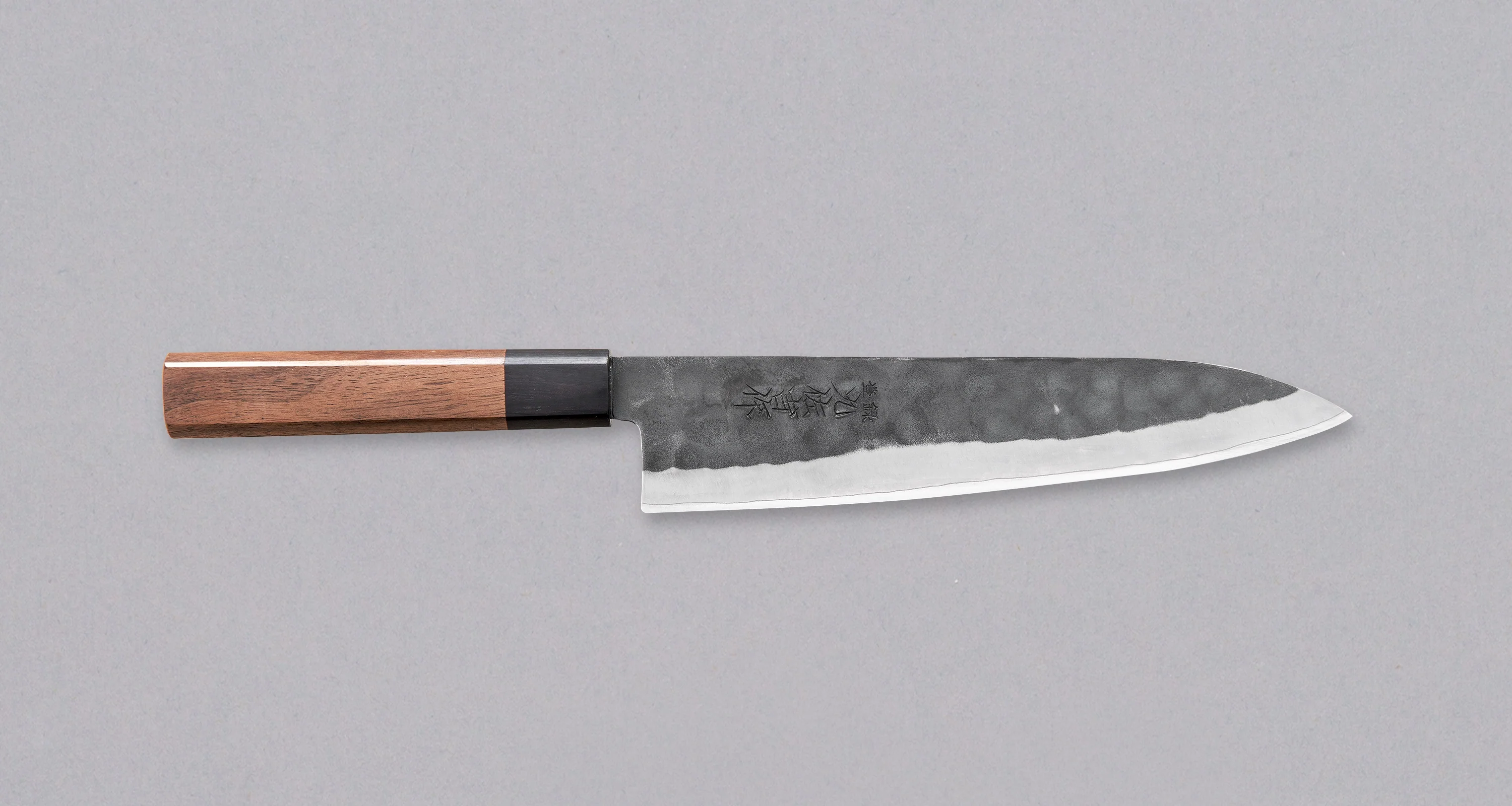
Yoshida Santoku Funayuki SUJ-2 Kuro-uchi 155mm (6.1") [Magnolia]
Santoku Funayuki is a jack-of-all-trades in the kitchen and will excel at all types of chopping and slicing on the kitchen board; you might find it a touch short only for very large chunks of meat.
BLADE SHAPE:
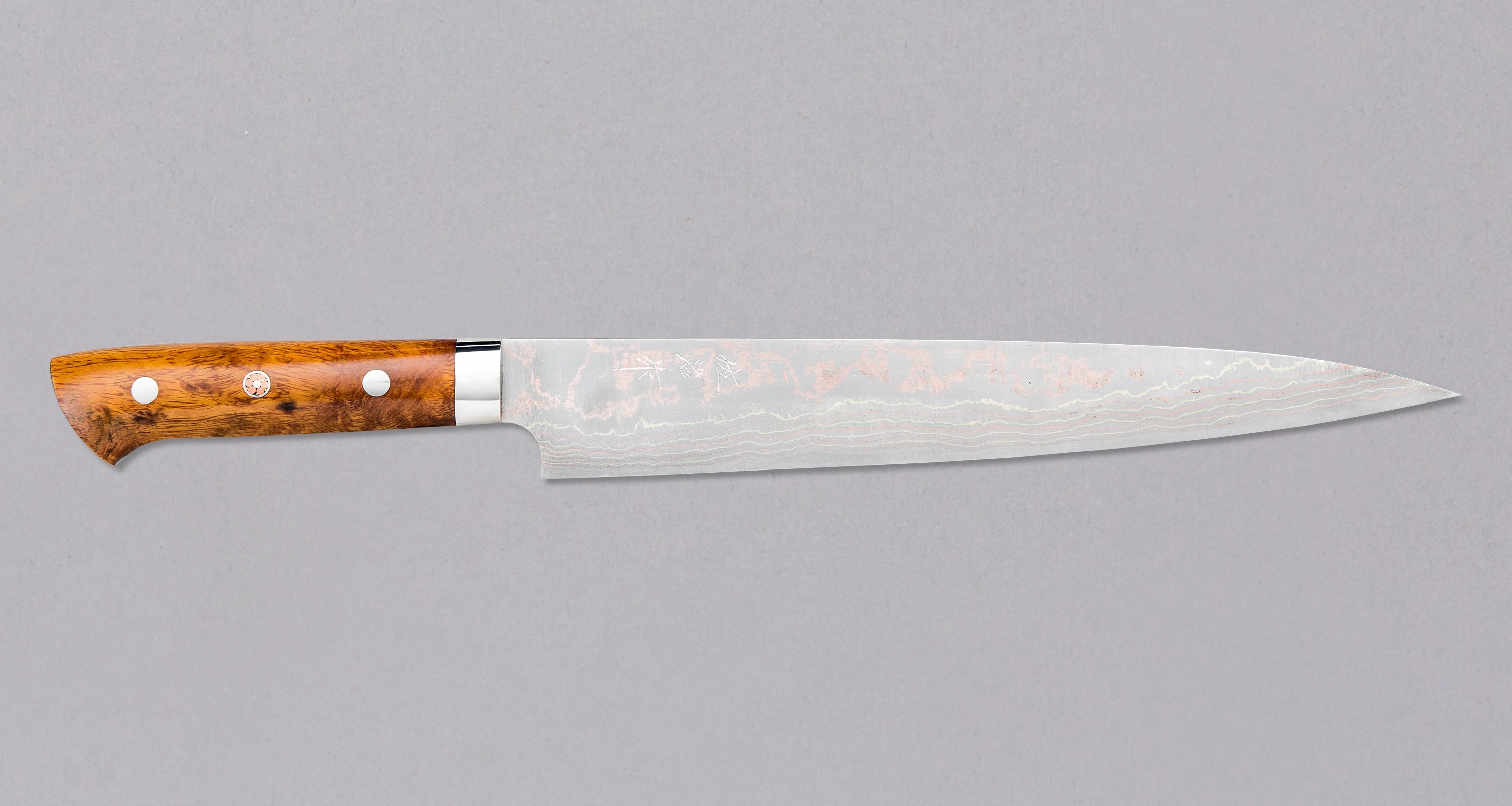
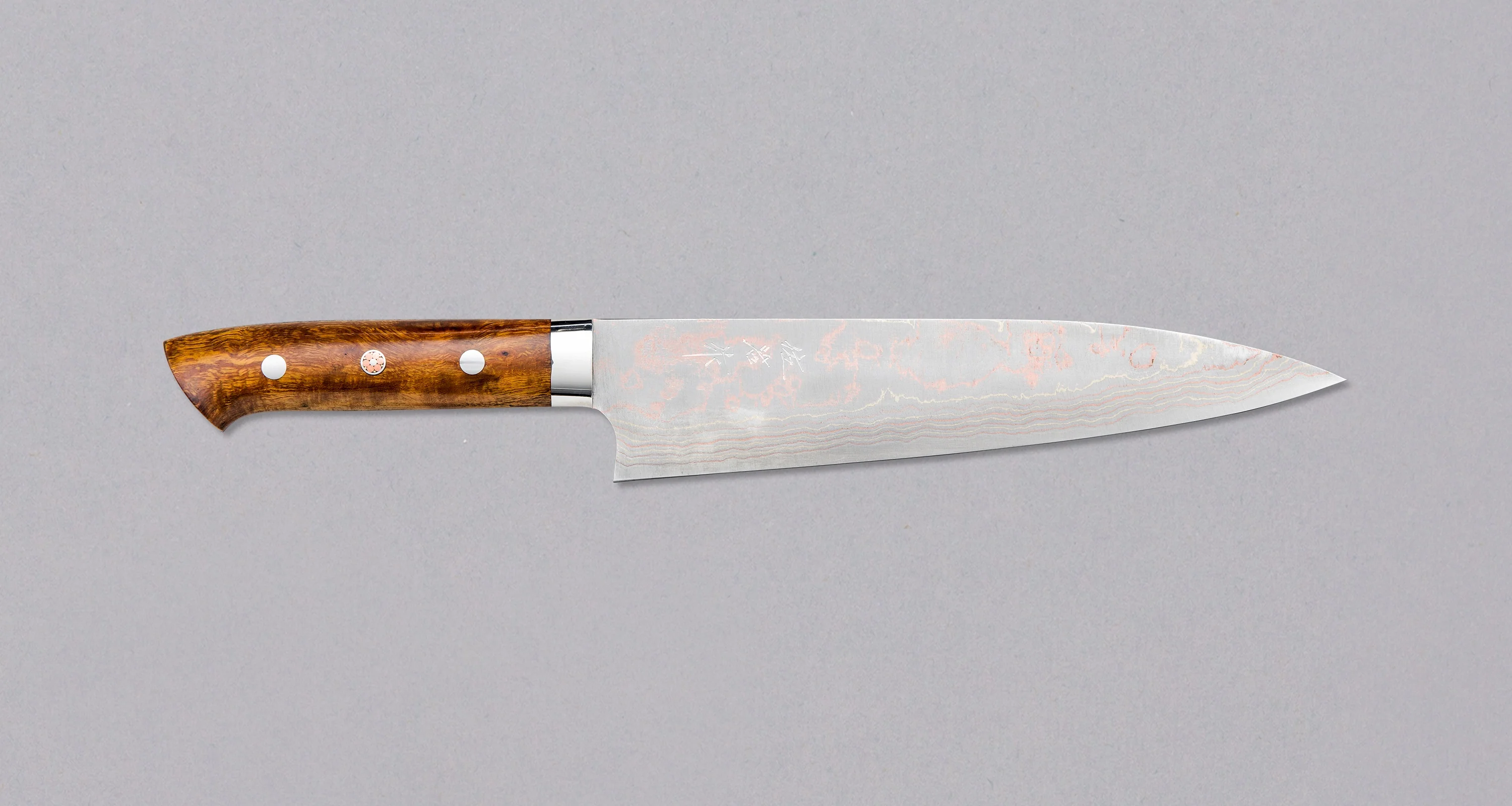
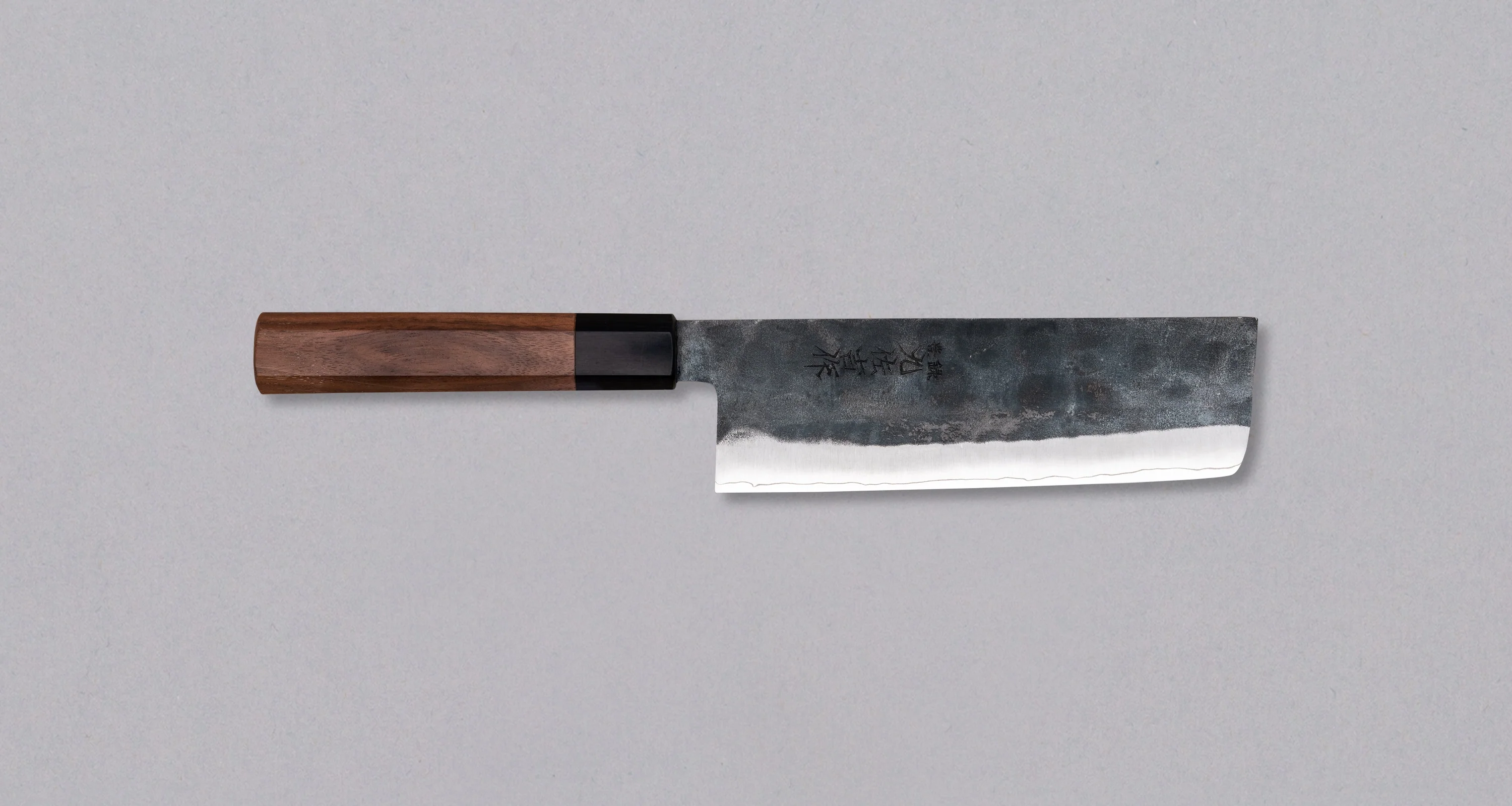
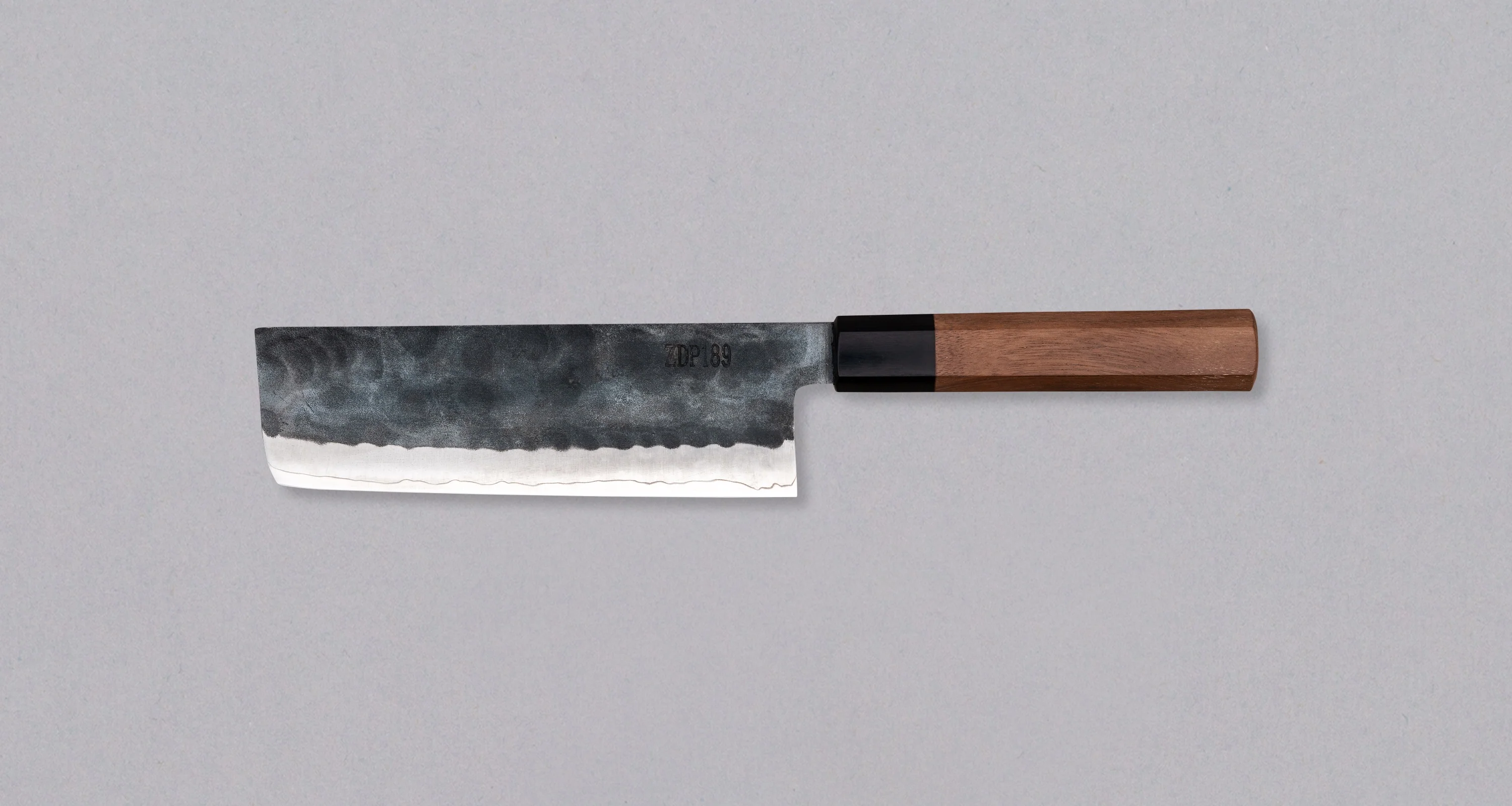
Compared to the basic Santoku knife shape, the spine of funayuki’s blade tapers towards the tip, creating a slight curve between the tip and the midsection. The standard shape of a santoku knife featuring a straight edge with a narrow sheep’s foot blade thus transforms into a blade that looks like a deba but is better suited to precision cutting, where you need really thin cuts (this makes it unsuitable for cutting through bones or making more robust cuts). As opposed to a forward and backward motion slicing technique that is characteristic of santoku knives, the curved belly requires a rocking back and forth motion. A pronounced tip and triangle design are perfect for cutting smaller pieces of meat and for filleting fish.
|
The word funayuki means “the boat (ocean) goes” and the knife was originally used on fishing boats, primarily as a lightweight fillet knife to test the quality of the catch, as well as to prepare meals at sea and perform a range of cleaning and prep jobs. |
In short: funayuki blade is a superb hybrid between various traditional shapes of Japanese knives, such as gyuto, santoku and deba, which makes it a versatile, all-around knife for various tasks in the kitchen.
STEEL:
Yoshida Kuro-uchi series knives are traditional Japanese rustic knives. Its price is very affordable for the quality of a hand-forged knife. It is suitable for the first purchase of a traditional Japanese knife. The blade is forged in SUJ-2 steel, which offers incredible capacities, hardness is 63-64 HRC, and at the same time the knife is very easy to resharpen. The blade needs some extra care. After the use rinse it well and dry it.
BLADE FINISH:
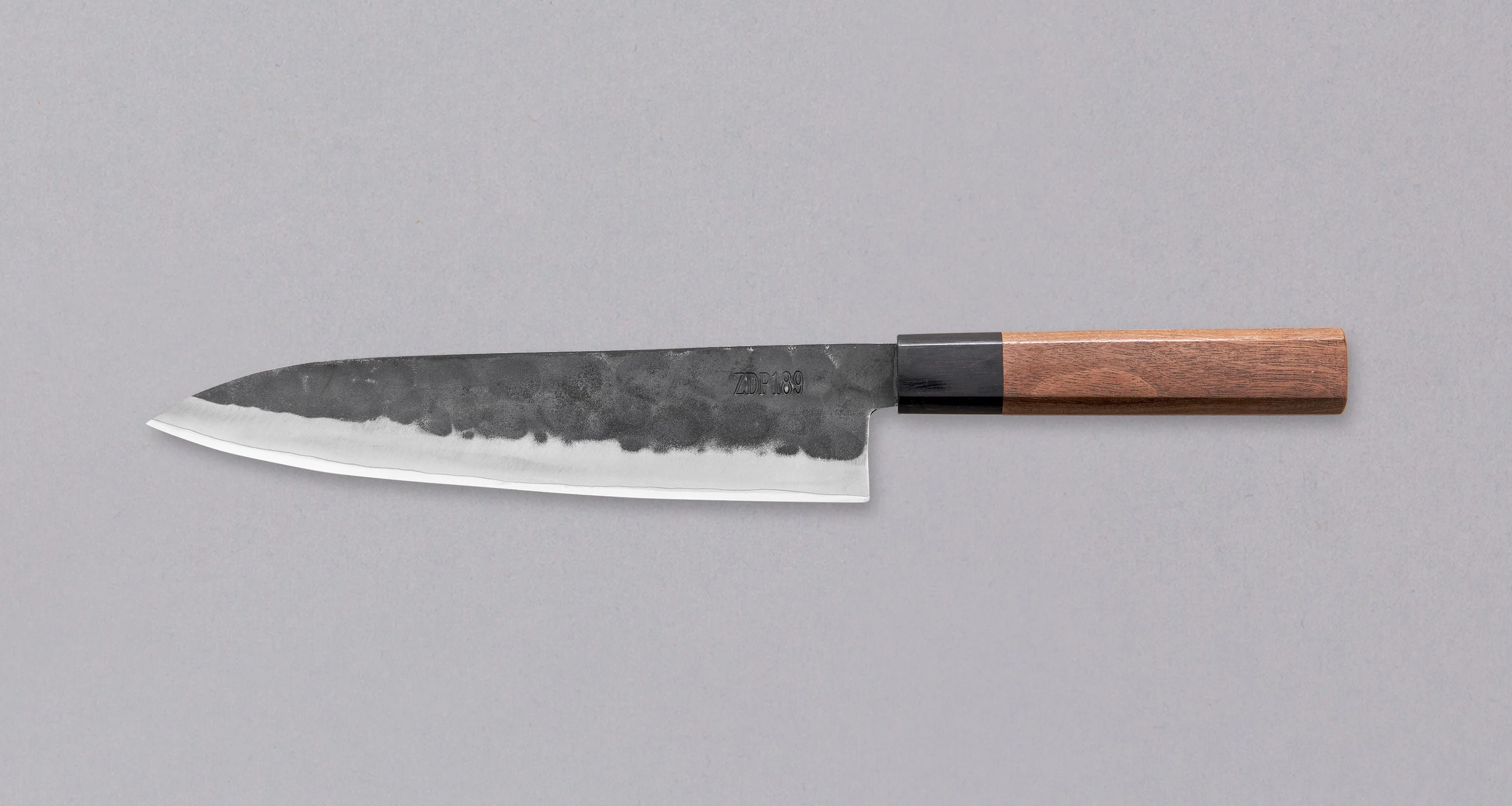
The name of kuro-uchi refers to the final look of the blade, which is unprocessed on the top and has already developed dark patina, which protects the blade.
HANDLE:
The handle is made of magnolia wood with a plastic ferrule.
ABOUT THE BLACKSMITH:
The knife is manufactured at the smithy of Yoshida Hamono in Japan, a family company with an age-long tradition in manufacturing state-of-the-art tools and Japanese swords, i.e. katanas, by hand. Yoshida Hamono has a great deal of experience forging ZDP-189 steel in the traditional manner.
Yoshida Santoku Funayuki SUJ-2 Kuro-uchi 155mm (6.1") [Magnolia]
Santoku Funayuki is a jack-of-all-trades in the kitchen and will excel at all types of chopping and slicing on the kitchen board; you might find it a touch short only for very large chunks of meat.
BLADE SHAPE:
Compared to the basic Santoku knife shape, the spine of funayuki’s blade tapers towards the tip, creating a slight curve between the tip and the midsection. The standard shape of a santoku knife featuring a straight edge with a narrow sheep’s foot blade thus transforms into a blade that looks like a deba but is better suited to precision cutting, where you need really thin cuts (this makes it unsuitable for cutting through bones or making more robust cuts). As opposed to a forward and backward motion slicing technique that is characteristic of santoku knives, the curved belly requires a rocking back and forth motion. A pronounced tip and triangle design are perfect for cutting smaller pieces of meat and for filleting fish.
|
The word funayuki means “the boat (ocean) goes” and the knife was originally used on fishing boats, primarily as a lightweight fillet knife to test the quality of the catch, as well as to prepare meals at sea and perform a range of cleaning and prep jobs. |
In short: funayuki blade is a superb hybrid between various traditional shapes of Japanese knives, such as gyuto, santoku and deba, which makes it a versatile, all-around knife for various tasks in the kitchen.
STEEL:
Yoshida Kuro-uchi series knives are traditional Japanese rustic knives. Its price is very affordable for the quality of a hand-forged knife. It is suitable for the first purchase of a traditional Japanese knife. The blade is forged in SUJ-2 steel, which offers incredible capacities, hardness is 63-64 HRC, and at the same time the knife is very easy to resharpen. The blade needs some extra care. After the use rinse it well and dry it.
BLADE FINISH:
The name of kuro-uchi refers to the final look of the blade, which is unprocessed on the top and has already developed dark patina, which protects the blade.
HANDLE:
The handle is made of magnolia wood with a plastic ferrule.
ABOUT THE BLACKSMITH:
The knife is manufactured at the smithy of Yoshida Hamono in Japan, a family company with an age-long tradition in manufacturing state-of-the-art tools and Japanese swords, i.e. katanas, by hand. Yoshida Hamono has a great deal of experience forging ZDP-189 steel in the traditional manner.
Product Information
Product Information
Shipping & Returns
Shipping & Returns
Description
Santoku Funayuki is a jack-of-all-trades in the kitchen and will excel at all types of chopping and slicing on the kitchen board; you might find it a touch short only for very large chunks of meat.
BLADE SHAPE:
Compared to the basic Santoku knife shape, the spine of funayuki’s blade tapers towards the tip, creating a slight curve between the tip and the midsection. The standard shape of a santoku knife featuring a straight edge with a narrow sheep’s foot blade thus transforms into a blade that looks like a deba but is better suited to precision cutting, where you need really thin cuts (this makes it unsuitable for cutting through bones or making more robust cuts). As opposed to a forward and backward motion slicing technique that is characteristic of santoku knives, the curved belly requires a rocking back and forth motion. A pronounced tip and triangle design are perfect for cutting smaller pieces of meat and for filleting fish.
|
The word funayuki means “the boat (ocean) goes” and the knife was originally used on fishing boats, primarily as a lightweight fillet knife to test the quality of the catch, as well as to prepare meals at sea and perform a range of cleaning and prep jobs. |
In short: funayuki blade is a superb hybrid between various traditional shapes of Japanese knives, such as gyuto, santoku and deba, which makes it a versatile, all-around knife for various tasks in the kitchen.
STEEL:
Yoshida Kuro-uchi series knives are traditional Japanese rustic knives. Its price is very affordable for the quality of a hand-forged knife. It is suitable for the first purchase of a traditional Japanese knife. The blade is forged in SUJ-2 steel, which offers incredible capacities, hardness is 63-64 HRC, and at the same time the knife is very easy to resharpen. The blade needs some extra care. After the use rinse it well and dry it.
BLADE FINISH:
The name of kuro-uchi refers to the final look of the blade, which is unprocessed on the top and has already developed dark patina, which protects the blade.
HANDLE:
The handle is made of magnolia wood with a plastic ferrule.
ABOUT THE BLACKSMITH:
The knife is manufactured at the smithy of Yoshida Hamono in Japan, a family company with an age-long tradition in manufacturing state-of-the-art tools and Japanese swords, i.e. katanas, by hand. Yoshida Hamono has a great deal of experience forging ZDP-189 steel in the traditional manner.